
Charles Bennett awarded the Turing prize
Charles Bennett, adjunct professor at MATH and honorary doctor at UCPH, receives the ACM A.M. Turing Award, together with Giles Brassard for Foundational Contributions to Quantum Information Science
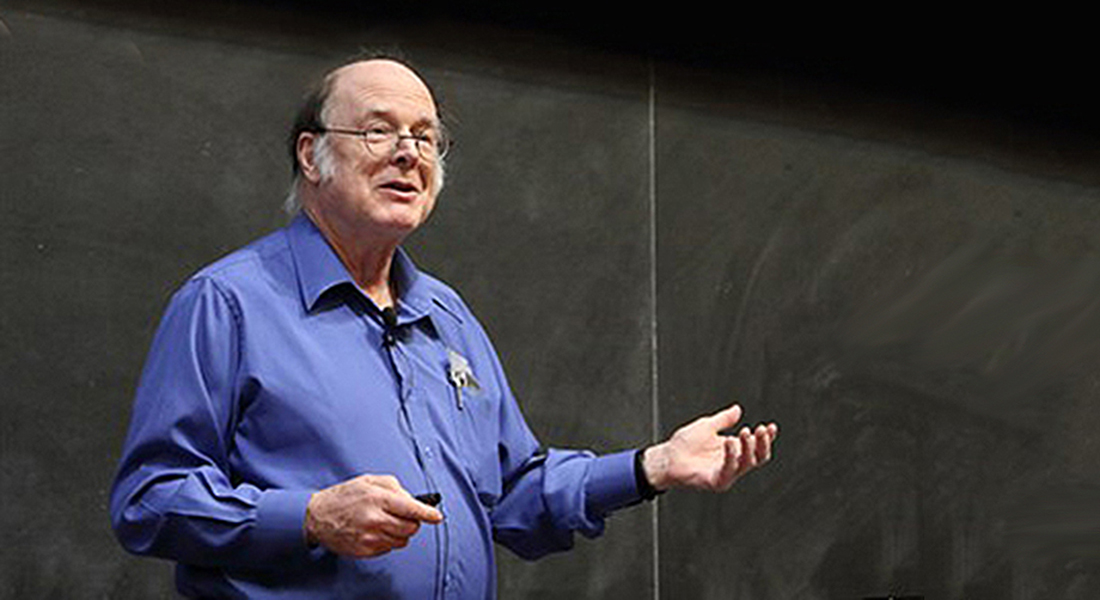
The Turing Award comes with a prize of $1 million, sponsored by Google, and is named after Alan M. Turing, a pioneer in modern computer science. The award is often regarded as the ‘Nobel Prize of computer science’.
Charles H. Bennett was appointed adjunct professor at the Department of Mathematical Sciences in 2020 after having followed and supported the department’s quantum information researchers for a number of years. He was among the keynote speakers at the opening conference of the Centre for the Mathematics of Quantum Theory (QMATH) in 2016. In 2019, he was appointed Honorary Professor at the University of Copenhagen.
“Charles Bennett was instrumental in the formation of QMATH and remains a very welcome visitor, dropping by once a year. Charles Bennett's curiosity about science has led him to groundbreaking insights into the nature of information, and indeed, quantum information. Charles and his wife really enjoy spending time in Copenhagen, and it is always a pleasure to see him share his enthusiasm and curiosity with students and postdocs during his visits”, says Matthias Christandl, one of the principal investigators of QMATH.
Founders of quantum information science
Bennett and Brassard are recognised as founders of quantum information science, a field uniting physics and computer science by treating quantum phenomena as resources for processing and transmitting information. In 1984, inspired by Stephen Wiesner, they introduced BB84, the first practical quantum cryptography protocol. Their paper, “Quantum Cryptography: Public Key Distribution and Coin Tossing,” showed how two parties could establish provably secure encryption keys based on the laws of physics, even against adversaries with unlimited computational power.
Classical public‑key cryptography relies on mathematical assumptions later shown to be vulnerable to quantum computers. In contrast, BB84 provides information‑theoretic security by exploiting a fundamental quantum property: information cannot be measured or copied without disturbance, making eavesdropping detectable. As concern grows over the long‑term security of classical cryptography, BB84 variants have already been deployed in fibre-based and satellite quantum communication networks worldwide.
Beyond cryptography, Bennett and Brassard profoundly influenced computing theory. In 1993, they and collaborators introduced quantum teleportation, demonstrating how quantum states can be transmitted using entanglement and classical communication. Once a philosophical curiosity, entanglement has become a practical resource, later honoured by the 2022 Nobel Prize in Physics. Their 1996 work on entanglement distillation enabled the strengthening of imperfect entanglement, a key step toward scalable quantum networks and a future quantum internet.
Over four decades, their collaboration bridged physics and computer science, shaping cryptography, algorithms, complexity theory, and mathematical physics, and inspiring generations of interdisciplinary researchers.
“Bennett and Brassard fundamentally changed our understanding of information itself,” said ACM President Yannis Ioannidis. “Their insights expanded the boundaries of computing and continue to drive discovery across disciplines.”
Their recognition coincides with the United Nations’ designation of 2025 as the International Year of Quantum Science and Technology. Many current efforts in quantum computing, communication, and sensing trace directly to their theoretical breakthroughs, with teleportation and entanglement now central to practical quantum engineering.

See the video with Charles Bennett about his research and the Turing-prize. Fom IBM Research.
 About the A.M. Turing Award
Established in 1966 and named for Alan M. Turing, the award honours individuals whose work has profoundly advanced the foundations and practice of computing.