
Spectral Geometry and its Relations to Minimal Surfaces
Copenhagen Centre for Geometry & Topology (GeoTop) at the University of Copenhagen
August 17-21 2026,
 Press on the picture or here to upload a bigger picture.
The aim of this masterclass is to explore the interplay between Spectral Geometry and Minimal Surface theory. Minimal surfaces, one of the oldest topics in geometry, concern special surfaces that are locally area-minimizing. Spectral geometry, famously popularized by Kac’s famous question “Can one hear the shape of a drum?”, studies the eigenfunctions and eigenvalues associated with differential operators on manifolds. This masterclass is designed to introduce the exciting interactions between these two areas, present recent developments, and highlight open problems and directions for future research.
The masterclass will consist of three lecture series by Misha Karpukhin, Vanderson Lima, and Romain Petrides.
The course is intended for MSc students, PhD candidates, and postdoctoral researchers working in differential geometry, geometric analysis, PDE, Spectral theory, and related areas.
Limited funding will be available for participants.
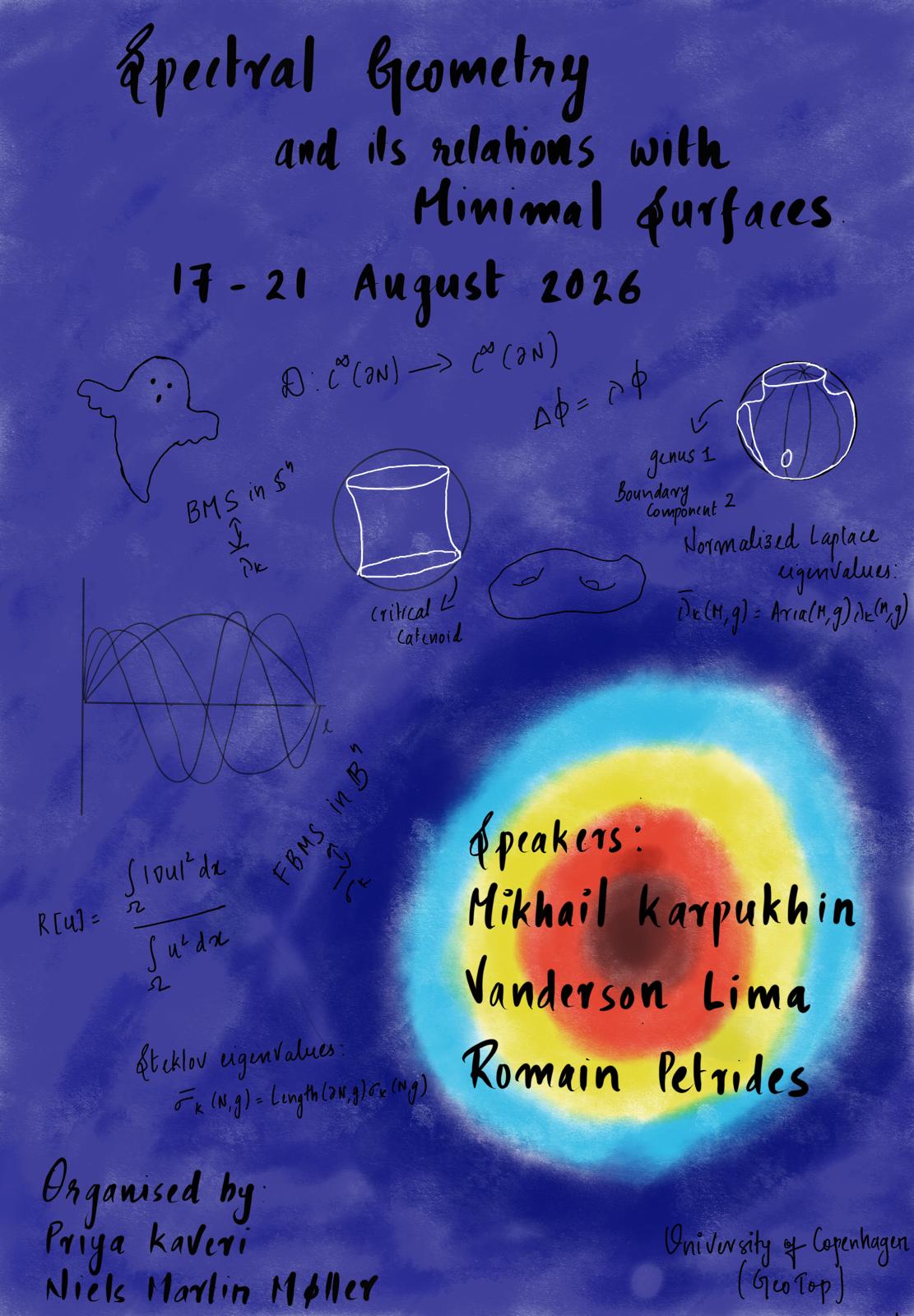
Click here to see a bigger version of the poster
Mikhail Karpukhin (UCL ᴜᴋ)
Title: Equivariant minimal surfaces and spectral geometry
The study of sharp upper bounds for Laplacian eigenvalues under area constraints is a classical topic in spectral geometry. A key source of interest lies in the remarkable fact that metrics achieving equality in such bounds correspond to metrics induced by minimal surfaces in spheres. A similar correspondence exists between optimisers of Steklov eigenvalues and free boundary minimal surfaces in the ball. These connections become especially powerful in the presence of a rich finite group of isometries. In this series of lecture we will discuss recent advances in the field such as (1) constructions of new families of minimal surfaces in low-dimensional targets; (2) estimates on the index of minimal surfaces and (3) uniqueness of minimal surfaces under symmetry assumptions. The course will focus on applying the ideas from spectral theory to classical problems in geometric analysis.
Vanderson Lima (UNB ʙʀ)
Title: Eigenvalue problems and free boundary minimal surfaces in spherical caps
Romain Petrides (IMJ-PRG ꜰʀ)
Title: Variational methods on eigenvalue functionals and applications
Throughout the course, we will illustrate these methods through examples drawn from two main areas of application: (1) the computation of sharp geometric bounds for eigenvalue problems; (2) the construction of solutions to geometric nonlinear partial differential equations by eigenvalue optimisation.
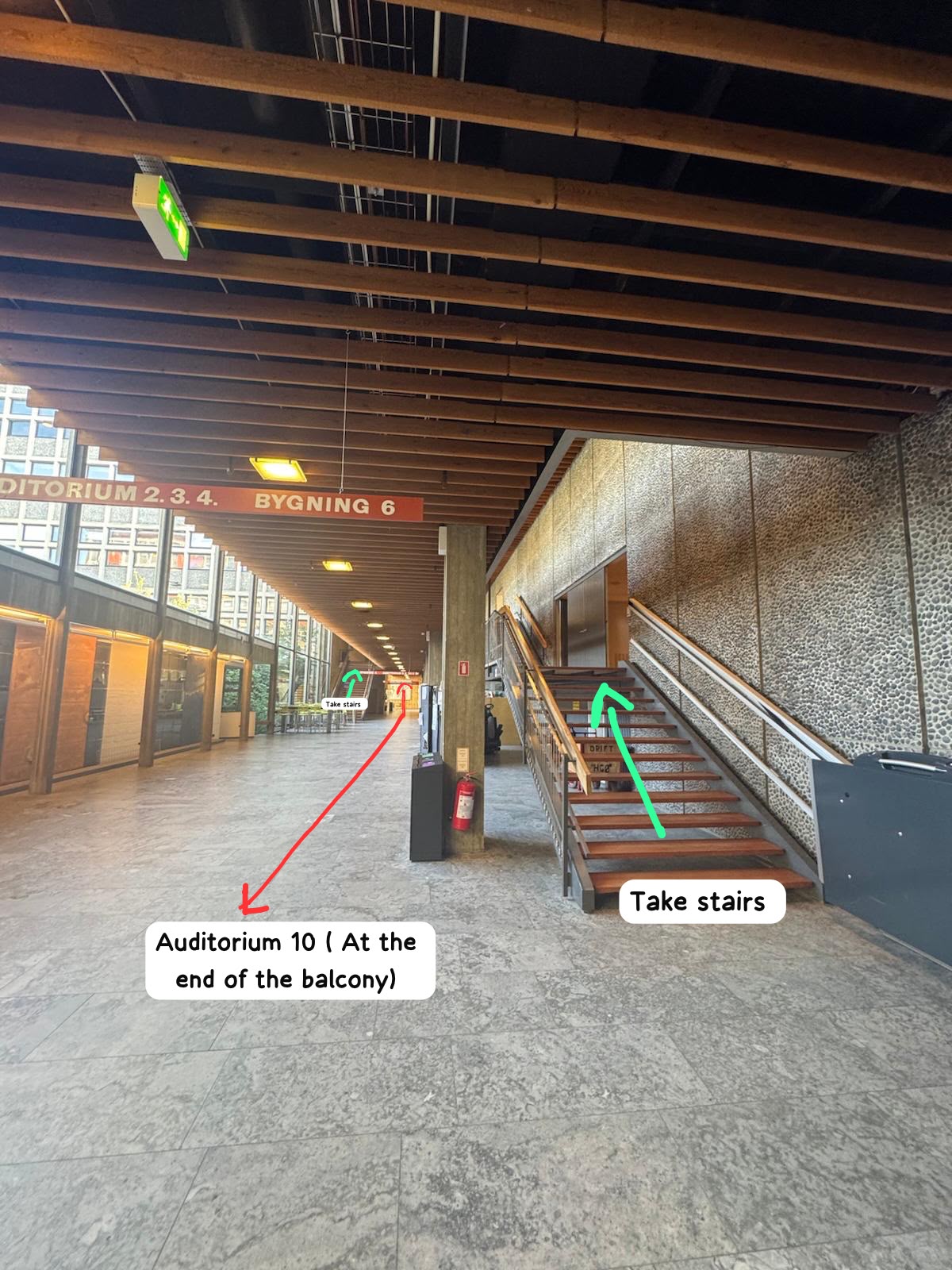
Registration and all lectures will take place in Auditorium 10, H.C. Ørsted Building, Universitetsparken 5, which is located at the end of the "balcony (indoors)".
(Google Maps link to the location of the masterclass (Aud 10)),
Once you enter the long corridor, this is one way to reach Aud 10.
Click here to see the schedule
Reception with pizza and drinks will happen here at 18:00 on Monday.
The social dinner will take place in the Food Club near Rådhuspladsen at 18:30 on Thursday.
The conference/masterclass will take place at the Department of Mathematical Sciences, University of Copenhagen. See detailed instructions on how to reach Copenhagen and the conference venue.
Tickets and passes for public transportation can be bought at the Copenhagen Airport and every train or metro station. You can find the DSB ticket office on your right-hand side as soon as you come out of the arrival area of the airport. DSB has an agreement with 7-Eleven, so many of their shops double as selling points for public transportation.
A journey planner in English is available.
More information on the "find us" webpage.
Registration is closed.
Priya Kaveri, pkvv@math.ku.dk
Niels Martin Møller, nmoller@math.ku.dk
Administrator: Jan Tapdrup, jt@math.ku.dk