Workshop on Geometry and PDEs
U Copenhagen
September 24-26, 2025
Speakers:
- Benjy Firester (MIT)
- Brian Harvie (UCPH, GeoTop)
- Paul Laurain (U Gustave Eiffel, Paris)
- Léo Morin (UCPH, QMATH)
- Andrea Nützi (Stanford/EPFL)
- Artemis Vogiatzi (UCPH, GeoTop)
- Louis Yudowitz (KTH)
Schedule: (URLs below, as e.g. HCØ Aud 9, lead to Google Maps pins)
Wed 24/9:
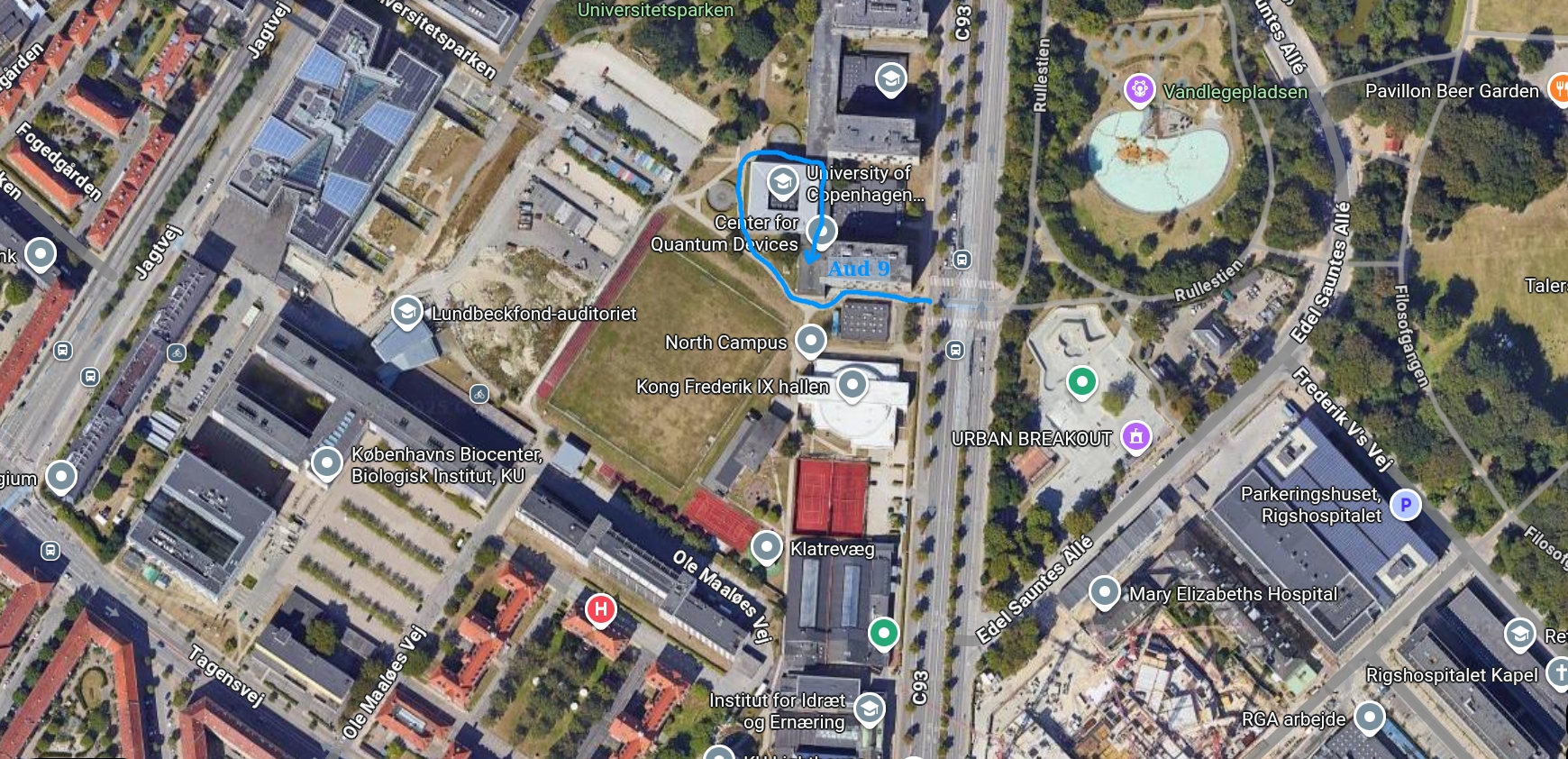
09:30-10:00: Welcome & coffee/tea ☕ [By HCØ Aud 9, 1st floor. See Path f/ road to room (.jpeg) 🗺️]
10:00-11:00: Laurain 🇫🇷 [HCØ Aud 9]
11:00-11:30: Coffee/tea ☕
11:30-12:30: Vogiatzi 🇬🇷/🇩🇰 [HCØ Aud 9]
12:30-14:00: Lunch break 🍽️
14:00-15:00: Morin 🇫🇷/🇩🇰 [HCØ 4.4.20]
Thu 25/9:
09:30-10:00: Coffee/tea ☕ [HCØ 4.4.19]
10:00-11:00: Nützi 🇨🇭/🇺🇸/🇸🇪 [HCØ 4.4.20]
11:00-11:30: Coffee/tea ☕
11:30-12:30: Firester 🇺🇸 [HCØ 4.4.20]
12:30-14:00: Lunch break 🍽️
14:00-15:00: Yudowitz 🇺🇸/🇸🇪 [Goth Aud 1] NB: Campus near Nørreport(!)
18:00: Walk to the restaurant [Food Club Nørrebro] - register here! (Info/address below)
18:45-20:45: Dinner 🍽️
Fri 26/9:
09:30-10:00: Coffee/tea ☕ [At entrance to Zoo Aud A]
10:00-11:00: Harvie 🇺🇸/🇩🇰 [Zoo Aud A]
11:30--: Lunch & goodbyes
Format: Talks are 45 minutes + questions.
Venue & rooms:
GeoTop, Dept. of Mathematical Sciences, U Copenhagen, Universitetsparken 5, DK-2100 Copenhagen
🧭 GPS Coordinates: 55,70061° N, 12,56055° E
📍Google Maps: https://maps.google.com/?q=55.70061,12.56055
HCØ Aud 9: (1st floor - walk up the stairs by the math library)
📍Google Maps:https://maps.google.com/?q=55.70022,12.5608
HCØ 4.4.19: (4th floor of the MATH building)
📍Google Maps:https://maps.google.com/?q=55.70047,12.56086
HCØ 4.4.20: (4th floor of the MATH building)
📍Google Maps: https://maps.google.com/?q=55.70042,12.56083
Zoo Aud A (ground floor on the right)
📍Google Maps:https://maps.google.com/?q=55.70179, 12.55878
Goth Aud 1 (1st floor up the stairs)
📍Google Maps: https://maps.google.com/?q=55.68585, 12.57027
Lunches:
NBB Canteen (Niels Bohr Building):
📍Google Maps: https://maps.google.com/?q=55.701029,12.557390
Transport
DSB ticket app: (NB: Has a "Check in"-"Check out" function!)
🇬 Google Play: https://play.google.com/store/apps/details?id=dk.dsb.nda.android
🍏 Apple App Store: https://apps.apple.com/dk/app/dsb-app/id1438634111
Travel planner:
https://rejseplanen.dk/webapp/?language=en_EN
Registration: Open for all interested.
If you plan to join for coffees/lunches/dinner:
Registration has closed
Dinner details: Thursday 25/9, 18:45--
Food Club Nørrebro (a buffet place)
Sortedam Dossering 7C, DK-2200 København
Titles & Abstracts
Speaker: Benjy Firester
Title: On a general class of free boundary Monge-Ampère equations
Abstract: Monge–Ampère and optimal transport equations arise naturally in geometric analysis and convex geometry, including the construction of Kähler–Einstein/Kähler-Ricci soliton metrics, the Minkowski problem (and its generalizations Lp affine surface measures), and convex analysis. Under suitable conditions, the optimal transport map is the gradient of a convex potential solving a related Monge-Ampère problem, thereby reducing the transportation problem to a fully nonlinear second-order elliptic equation. This duality between transport and Monge–Ampère has since been extended to diverse geometric contexts and has received much attention due to its many applications.
In this talk, I will present a variational framework to solve a general class of free-boundary Monge–Ampère equations. This approach combines the classical first and second boundary value problems by imposing both the boundary data and the gradient image of the solution. We consider applications to optimal transport with degenerate densities (with connections to its regularity theory), the Monge–Ampère eigenvalue problem and a reconstruction theorem, and geometric problems including a hemispherical Minkowski problem and the construction of free boundary toric Kähler–Einstein/Kähler-Ricci soliton metrics.
Speaker: Brian Harvie
Title: Static Vacuum Black Holes with a Negative Cosmological Constant
Abstract: An asymptotically locally hyperbolic (ALH) static space is a Riemannian manifold corresponding to an isolated static vacuum black hole with a negative cosmological constant in general relativity. The model solutions are warped product manifolds known as the Kottler metrics. An outstanding problem in mathematical general relativity, part of the broader "no-hair conjecture", is to determine if these are the unique ALH static spaces. There are very few results in this direction, which sharply contrasts with the wealth of static black hole uniqueness theorems for zero or positive cosmological constant.
In this talk, I will introduce a new geometric inequality for ALH static spaces which relates the surface gravity and topology of a horizon to the geometry at infinity. This inequality is saturated only by the Kottler black holes, and this leads to several new black hole uniqueness theorems. First, the spherical Kottler metric (also known as *anti deSitter Schwarzschild metric*) with critical surface gravity is unique. Second, the toroidal Kottler metric is unique under the assumption that the horizon does not contain topological two-spheres. Third, uniqueness of the hyperbolic Kottler metrics is equivalent to the conjectured Riemannian Penrose inequality for hyperbolic infinities, and in particular this implies static uniqueness for ALH graphs. This is joint work with Ye-Kai Wang of NYCU.
Speaker: Paul Laurain
Title: Minimal Discs in H3, Weil–Petersson Curves, Moving Frames, and Singular Harmonic Maps
Abstract: I will begin by presenting a result of de Oliveira stating that the boundary of a minimal disc in \mathbb{H}^3 with finite energy must be Lipschitz, together with his conjecture that such boundaries should in fact be C^1. We will then follow the subsequent developments, culminating in Bishop’s negative resolution of this conjecture: the boundary need only be a Weil–Petersson curve. After introducing the notion of Weil–Petersson curves, I will propose a new perspective on the problem based on moving frames. This approach naturally leads to a new viewpoint on the uniformization of planar domains, which can be seen as a first step toward a quantitative refinement of Bishop’s result.
This is joint work with A. Michelat, R. Petrides, and Y. Wang.
Speaker: Léo Morin
Title: Semiclassical normal forms for magnetic Laplacians
Abstract: This talk is devoted to the spectral analysis of magnetic Laplacians. I will present some normal forms for these operators, which provide precise description of the spectrum in the semiclassical limit. This work relies on a phase-space analysis using microlocal methods. The symplectic structure of the underlying characteristic manifold has strong influence on the spectrum of the operator.
Speaker: Andrea Nützi
Title: A support preserving homotopy for the de Rham complex with boundary decay estimates
Abstract: We construct a chain homotopy for the de Rham complex of relative differential forms on compact manifolds with boundary. This chain homotopy has desirable support propagation properties, and satisfies estimates relative to weighted Sobolev norms, where the weights measure decay near the boundary. The estimates are optimal given the homogeneity properties of the de Rham differential under boundary dilation. When applied to the radial compactification of Euclidean space, this construction yields, in particular, a right inverse of the divergence operator that preserves support on large balls around the origin, and satisfies estimates that measure decay near infinity. I will explain how this right inverse can then be used to also obtain a right inverse of the divergence operator on symmetric traceless matrices in three dimensions, and therefore of the linearized constraint operator of general relativity about flat space.
Speaker: Artemis Vogiatzi
Title: Quartically pinched submanifolds for the mean curvature flow in the sphere.
Abstract: We introduce a new sharp quartic curvature pinching for submanifolds in $\mathbb{S}^{n+m}$, $m\ge2$, which is preserved by the mean curvature flow. Using a blow up argument, we prove a codimension and a cylindrical estimate, where in regions of high curvature, the submanifold becomes approximately codimension one, quantitatively, and is weakly convex and moves by translation or is a self shrinker. With a decay estimate, the rescaling converges smoothly to a totally geodesic limit in infinite time, without using Stampacchia iteration.
Speaker: Louis Yudowitz
Title: Semi-Continuity of the Morse Index for Ricci Shrinkers
Abstract: When studying the compactness theory for solutions to geometric PDEs, one can encounter the formation of singularities. This occurs, for instance, for sequences of harmonic maps, Einstein manifolds, minimal surfaces, and gradient shrinking Ricci solitons. Provided the singular set consists of isolated points, a common strategy to study them is to construct a “bubble tree” through an iterative blow-up procedure. Moreover, supplementing this with analytic, geometric, and topological arguments allows for the recovery of information lost due to the bubbling behavior. In this talk I will discuss bubbling for gradient Ricci shrinkers, with a focus on how it affects the stability of singularity models for Ricci flow. In particular, I will give an overview of how to prove upper and lower semi-continuity of the Morse index for Ricci shrinkers by studying a certain weighted eigenvalue problem. I will also explain how the same techniques can be applied to show a quantitative relation between the stability of an asymptotically conical Ricci shrinker and that of its asymptotic cone.
- Niels Martin Møller (UCPH/GeoTop) 🇩🇰
- Francisco "Paco" Martín (U Granada) 🇪🇸