
Nancy Hingston Celebration
30-31 October 2025
 |
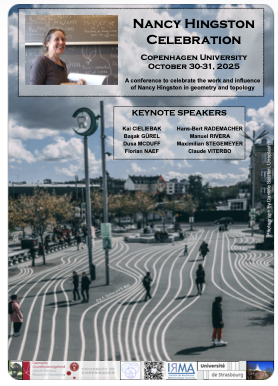 |
This is a conference to celebrate the work and influence of Nancy Hingston in geometry and topology.
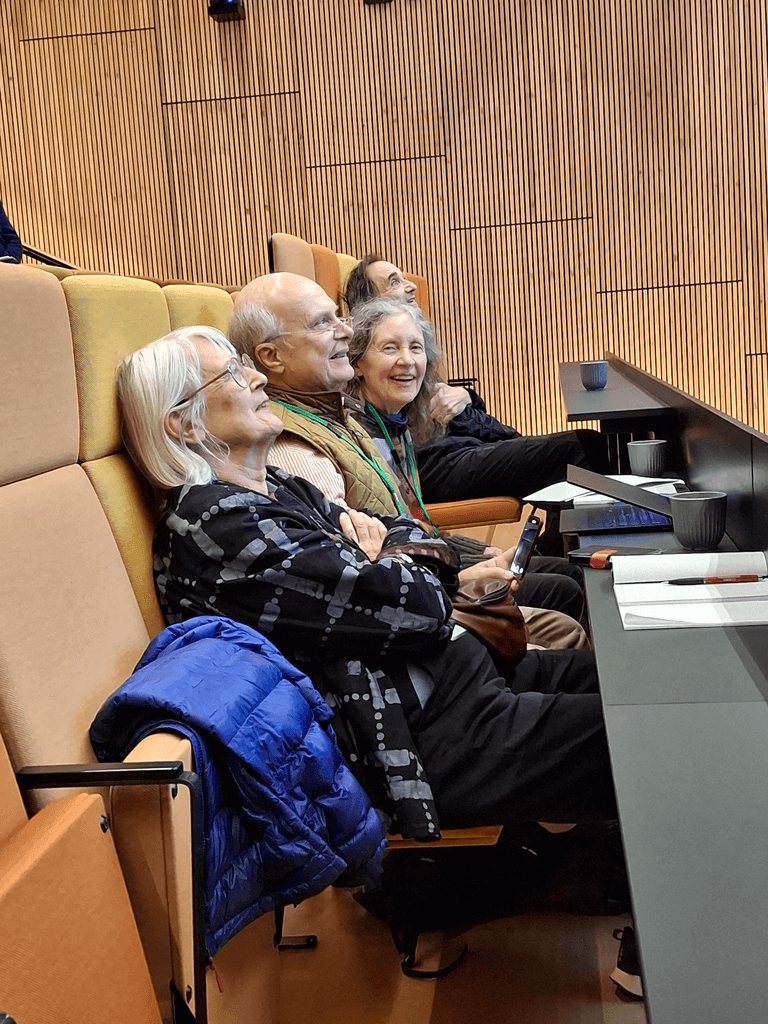 Nancy listening to the song "Nancy Hingston" by Boris Brawer and Helmut Hofer, created using Suno.AI for music generation and You.com AI for creative assistance: Country and Reggae versions, lyrics.
Kai Cieliebak
Title: Poincare duality for loop spaces
I will tell the story of how a question raised by Nancy Hingston in 2017 triggered a development in symplectic geometry and string topology which is still ongoing. Among others, it led to the discovery of Poincare duality for Rabinowitz Floer and new insights into graded Frobenius algebras, Tate vector spaces, resonances, and index growth.
Basak Gurel
Title: Towards the HZ- and multiplicity conjectures for dynamically convex Reeb flows
Dusa McDuff
Title: Embedding symplectic ellipsoids and constructing algebraic curves
I will describe recent work with Kyler Siegel that constructs enough curves to prove the stabilized embedding problem for the 4-ball and other toric surfaces. It will be a fairly general talk and understandable to nonspecialists.
Florian Naef
Title: The Goresky-Hingston coproduct as a manifold invariant
The Goresky–Hingston coproduct and the Chas–Sullivan product admit many striking analogies, and in several respects they can be viewed as either dual to one another or even as dual views of the same operation. However, there is at least one aspect where they seem to differ; the Goresky-Hingston coproduct is a stronger manifold invariant than the Chas-Sullivan product. The dependence on the manifold structure is somewhat curious. In a certain sense, it only enters through the fact that compact manifolds admit finite cell decompositions. I will try to give an overview and explanation of this phenomenon.
This is based on joint work with Pavel Safronov.
Hans-Bert Rademacher
Title: On the number of closed geodesics
It is a longstanding conjecture that any Riemannian metric on a closed manifold carries infinitely many closed geodesics. We discuss the important contributions by Nancy Hingston to this question using equivariant Morse theory on the free loop space and products on the homology resp. cohomology of the free loop space. On one hand she was able to handle the case when all closed geodesics are hyperbolic. On the other hand she considered metrics carrying a closed geodesic with nonnilpotent level (co)homology.
Manuel Rivera
Title: String topology and the coHochschild complex
I will describe a tractable chain model for the free loop space of a simplicial complex in terms of the coHochschild complex of a suitable coalgebra. The construction does not assume any restrictions on the fundamental group or the commutative ring of coefficients.
When the underlying simplicial complex is equipped with a local intersection product (e.g. a homology manifold), I will describe an explicit formula for the loop coproduct in terms of coHochschild chains. The formula uses local higher homotopies controlling the compatibility of intersections with the diagonal approximation coproduct. The locality condition guarantees that the failure of the loop coproduct on being compatible with the coHochschild differential lies in the subcomplex of constant loops.
Maximilian Stegemeyer
Title: Extensions of loop products and resonances of closed geodesics on real projective space
Properties of closed geodesics on Riemannian manifolds are a classical topic of mathematical research. The closed geodesics can be described as the critical points of the energy functional on the free loop space of the given manifold. Since string topology studies algebraic structures on the homology of free loop spaces, there is hope that string topology operations give new insight into closed geodesics.
In this talk we will see how one can obtain a resonance theorem for closed geodesics on real projective space. This is based on a corresponding result by Nancy Hingston and Hans-Bert Rademacher for spheres. Since even-dimensional real projective spaces are not orientable, the classical string topology operations are not defined in general and some extra care is required. We will show that a loop product and coproduct can be defined on the universal covering space of the free loop space of real projective spaces and that these operations can be understood as extensions of the loop product and coproduct on spheres. The explicit computation of these operations can be used to deduce a resonance theorem for real projective spaces.
Claude Viterbo
Gong show:
Liam Ashton
Title: A double bracket on the Lie module of paths
I will first give a brief overview of the Goldman Lie Algebra and a recently described Lie Module to the Goldman Lie Algebra curtesy of Kawazumi and Kuno. Then, I will describe a double Lie bracket (in the sense of Van der Bergh) built by intersecting paths on a surface with boundary. The end goal and motivation for the construction is to decompose the Goldman Lie algebra on a closed surface along a separating simple curve.
Jonathan Clivio
Title: The String Coproduct on the Based Loop Space
I will present some results for the Goresky-Hingston coproduct on the based loop space: a \pi_1-invariance result and a formula how it interacts with maps. This expands on earlier work by Nancy Hingston.
Mingyuan Hu
Title: Skein valued cluster theory and open Gromov-Witten invariants
For a Calabi-Yau threefold and a Lagrangian submanifold, I will introduce the wave function defined by Ekholm and Shende, which lives in the skein module, and encodes all-genus open Gromov-Witten invariants. I am going to very briefly explain how to use a skein-valued cluster theory to compute these wave functions. Examples include a class of Lagrangian submanifolds in C^3, homeomorphic to a handlebody.
Robin Riegel
Title: A Morse theoretical approach to the Chas-Sullivan product
We will discuss how to build (and generalize) a Morse model for a fundamental operation in string topology, the Chas-Sullivan product on the free loop space of a closed manifold. This approach is based on the work of Barraud, Damian, Humilière and Oancea who introduced Morse Homology with differential graded coefficients.
| Thursday | Friday | |
| 9:00 | Registration | |
| 10:00 | Rademacher | Gurel |
| 10:45 | Coffee | Coffee |
| 11:15 | Naef | Stegemeyer |
| 12:00 | Lunch | Lunch |
| 14:00 | Rivera |
McDuff |
| 14:45 | Coffee | Coffee and cake |
| 15:15 | Viterbo | Cieliebak |
| 16:00 |
Cake |
|
| 16:30 |
Gong show: Ashton, Riegel, Clivio, Hu |
|
| 18:30 |
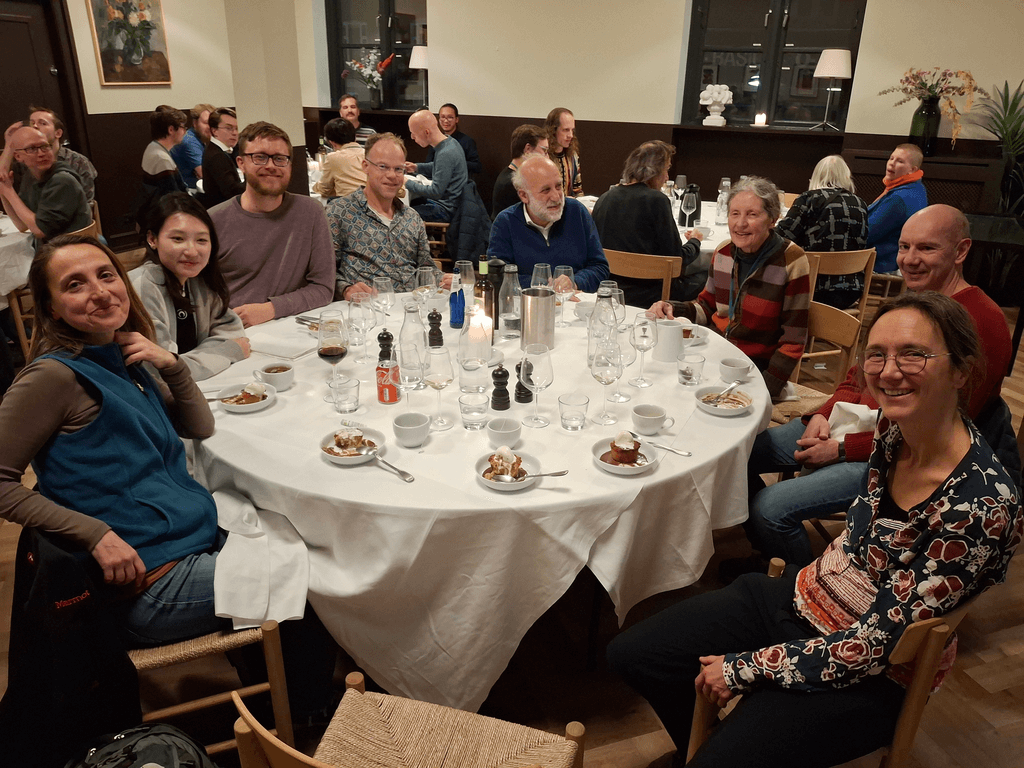
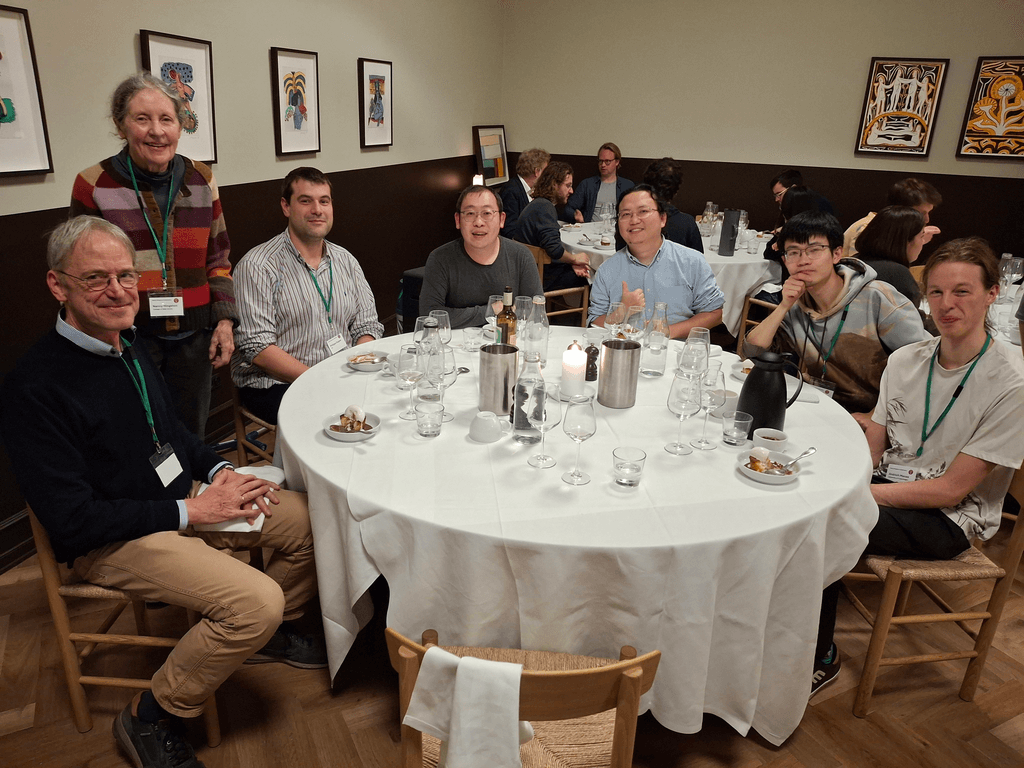
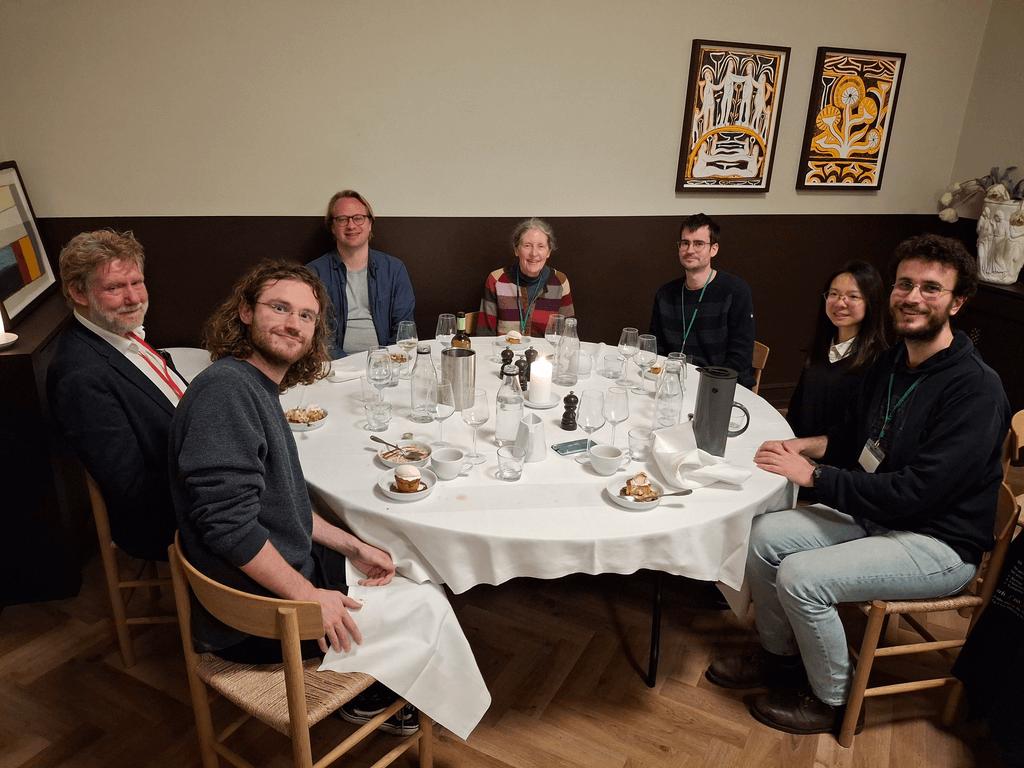
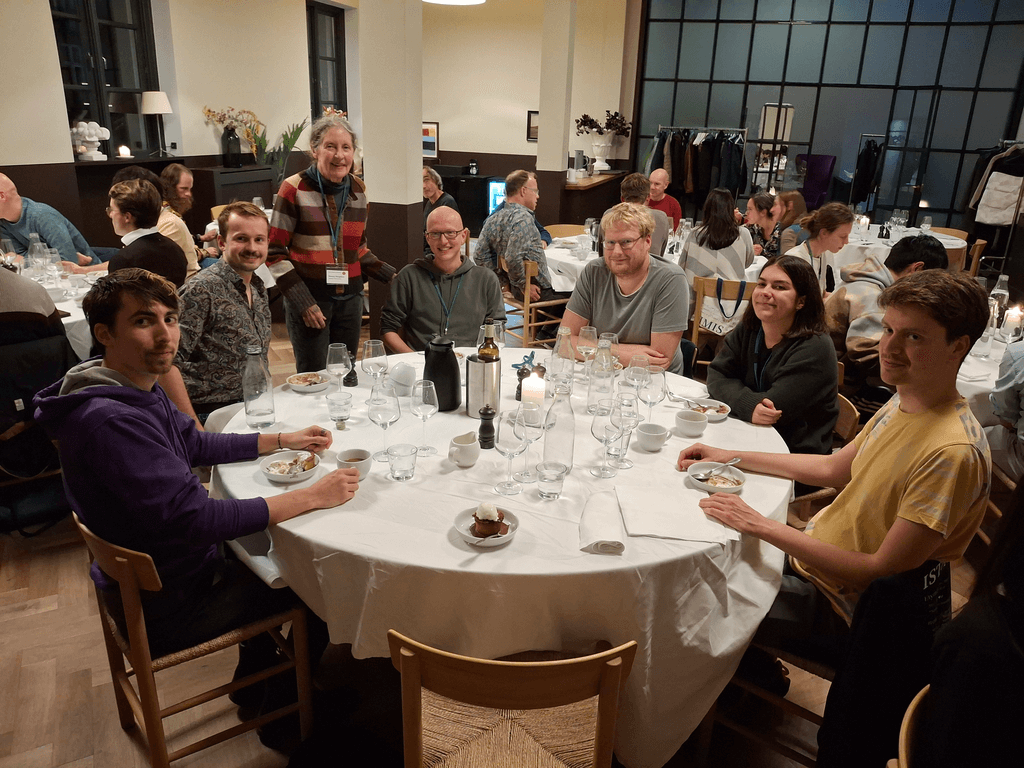
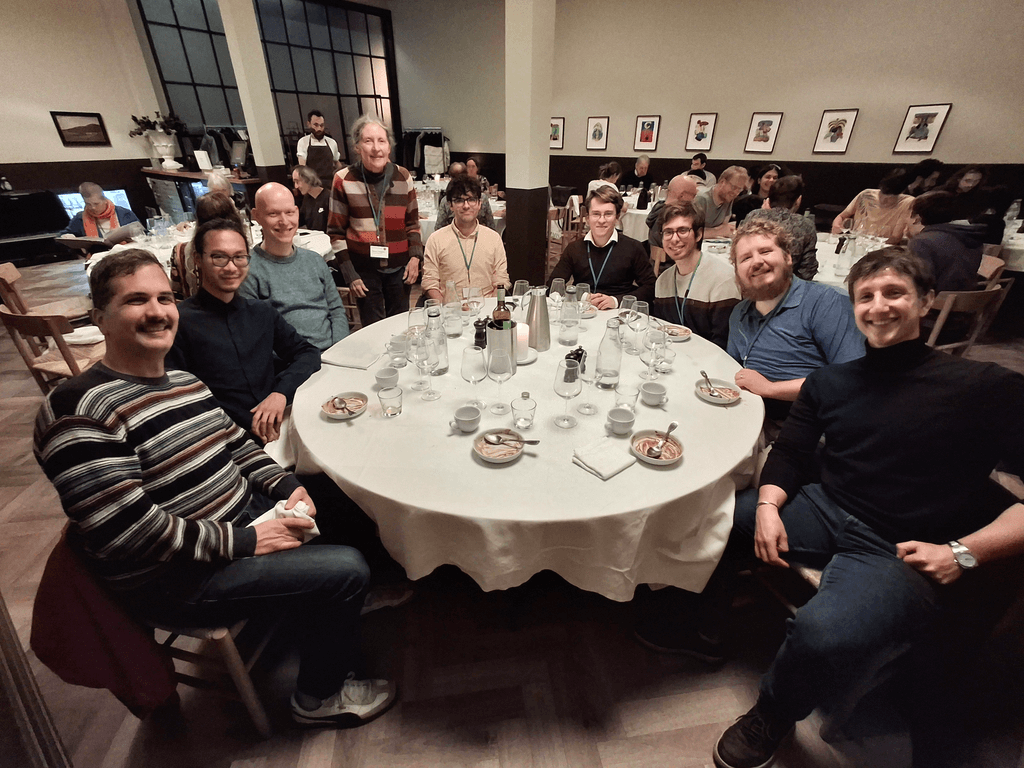
Dinner Venue: Madklubben Østerbro, |
The Margrethe Bohr Hall, The Niels Bohr Building, NBB 001-0-EF.000, University of Copenhagen, Jagtvej 132, 2200 Copenhagen. See Google coordinates.
We kindly ask the participants to arrange their own accommodation.
We recommend Hotel 9 Små Hjem, which is pleasant and inexpensive and offers rooms with a kitchen. Other inexpensive alternatives are Steel House Copenhagen (close to city centre), and CabInn, which has several locations in Copenhagen: the Hotel City (close to Tivoli), Hotel Scandinavia (Frederiksberg, close to the lakes), and Hotel Express (Frederiksberg) are the most convenient locations; the latter two are 2.5-3 km from the math department. Somewhat more expensive – and still recommended – options are Hotel Nora and Ibsen's Hotel.
An additional option is to combine a stay at the CabInn Metro Hotel with a pass for Copenhagen public transportation (efficient and reliable). See information about tickets & prices.
The registration deadline is past. Please contact the organizers if you would like to participate.
Participants:
Liam Ashton (Purdue U.)
Russell Avdek (CNRS, Paris)
Andrea Bianchi (MPIM Bonn)
Johanna Bimmermann (Oxford)
João Camarneiro (Edinburgh)
Kai Cieliebak (Augsburg)
Jonathan Clivio (Copenhagen)
Shah Faisal (Strasbourg)
Yanbo Fang (Aarhus)
Quincy Frias (George Mason U.)
Zhen Gao (Augsburg)
Jesper Grodal (Copenhagen)
Basak Gurel (Univ. Central Florida)
Hanna Haeussler (Univ Augsburg)
Nancy Hingston (College of New Jersey)
Mingyuan Hu (Univ. Southern Denmark)
Philippe Kupper (Karlsruhe)
Janko Latschev (Hamburg)
Shuaipeng Liu (Augsburg)
Han Lou (BICMR, Beijing)
Jindrich Manas (Copenhagen)
Dusa McDuff (Barnard College, Columbia U.)
Dominik Meidert (Augsburg)
Isaac Moselle (Copenhagen)
Florian Naef (Dublin)
José Luis Narbona Valiente (Cambridge)
Alexandru Oancea (Strasbourg)
Hans-Bert Rademacher (Leipzig)
Robin Riegel (Strasbourg)
Manuel Rivera (Purdue U.)
Thomas Rot (Amsterdam)
Franz Schels (Leipzig)
Alba Sendón Blanco (Amsterdam)
Maximilian Stegemeyer (Freiburg)
Claude Viterbo (Univ. Paris-Saclay)
Nathalie Wahl (Copenhagen)
Andreas Zamanian (Copenhagen)
Adela Zhang (Copenhagen)
Bingyu Zhang (Univ. Southern Denmark)
Wennan Zhang (Univ. Southern Denmark)
Organisers: Alexandru Oancea and Nathalie Wahl