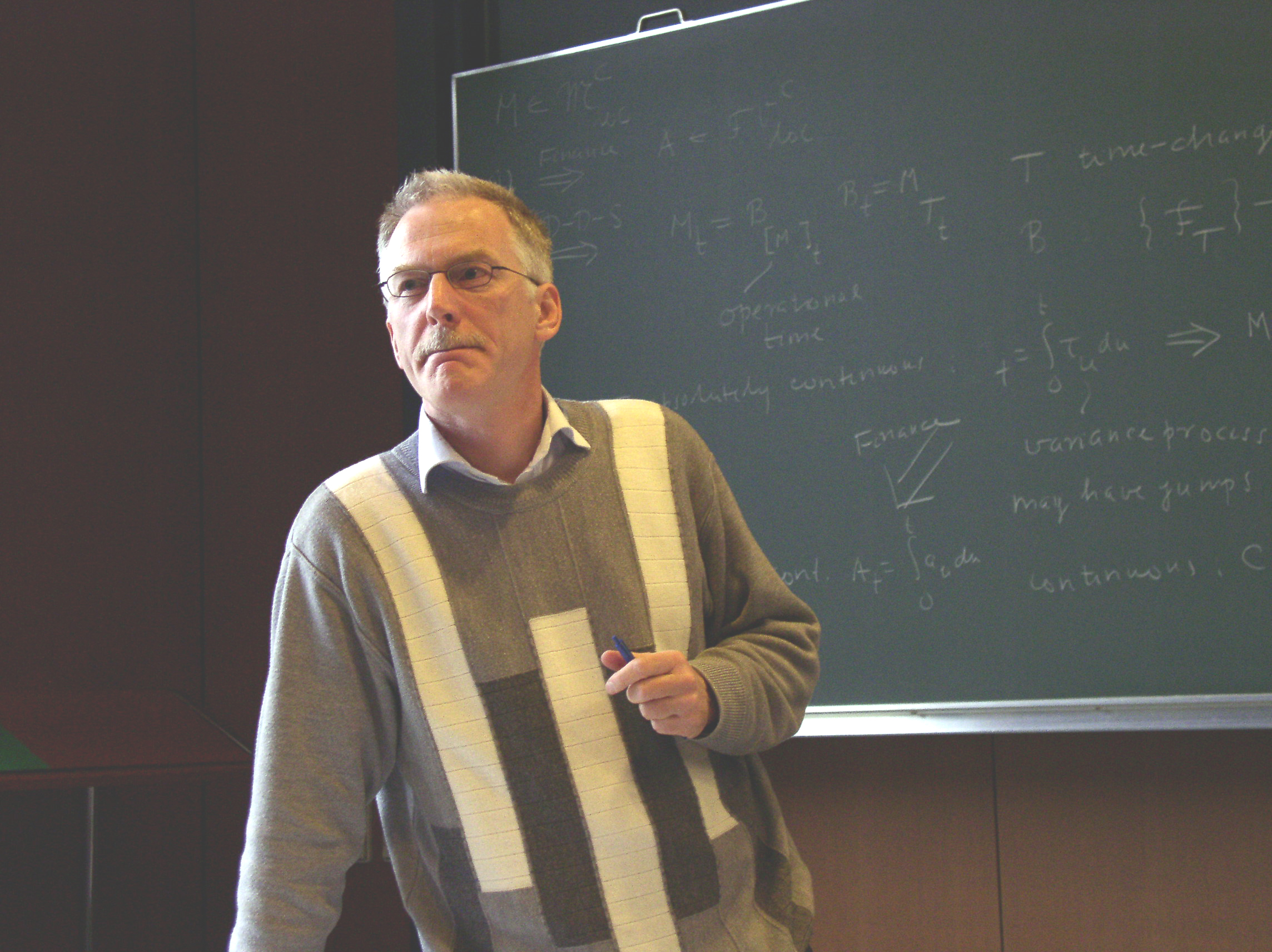
Address: Department of Mathematical Sciences, University of
Copenhagen, Universitetsparken 5, DK-2100 Copenhagen Ø, Denmark.
My main research interests are:
Statistical inference for stochastic
processes, in particular discrete time sampling of continuous time
processes such as models given by stochastic differential equations
and jump processes. The interaction between statistics and finance.
Stochastic models and related statistical problems, particularly
in the physics of blown sand, turbulence and biology.
Books:
You can read about my work on exponential families of
stochastic processes in my book
Exponential Families of Stochastic Processes, co-authored with Uwe
Küchler (Humboldt- University of Berlin).
Diffusion models for exchange rates in a target zone. Co-author:
Kristian Stegenborg Larsen. Mathematical Finance, 17,
2007, 285 - 306.
Dynamics of particles in aeolian saltation. Co-author:
Keld Rømer Rasmussen. In Garcia-Rojo, R., Herrmann, H.J. and
McNamara, S. (eds.): Powders and Grains 2005, Vol. 2,
Balkema, Rotterdam, 2005, 967 - 972.
Diffusion-type models with given marginal and autocorrelation function.
Co-authors: Bo Martin Bibby and Ib Michael Skovgaard. Bernoulli,
11, 2005, 191 - 220.
On time-reversibility and estimating functions for Markov processes.
Co-author: Mathieu Kessler. Statistical Inference for Stochastic
Processes, 8, 2005, 95 - 107.
Martingale estimating functions for discretely observed
stochastic differential equation models. In Romanelli, S., Mininni,
R.M. and Lucente, S. (eds.): Interplay between
(C_0)-semigroups and PDEs: Theory and applications. Aracne
Editrice, Rome, 2004, 213 - 236.
Inference for observations of integrated diffusion processes.
Co-author: S. Ditlevsen. Scand. J. Statist., 31,
2004, 417 - 429.
Estimation for discretely observed diffusions using transform
functions. Co-authors: Leah Kelly and Eckhard Platen. J. Appl.
Prob., 41A, 2004, 99 - 118.
On the rate of aeolian sand transport. Geomorphology,
59, 2004, 53 - 62.
A broad review is given of the theory of estimating functions for
discretely sampled diffusion-type processes. Martingale and non-martingale
estimating functions are presented for directly observed solutions to
stochastic differential equations. Particular attention is given to
explicit estimating functions. Prediction-based estimating functions
are presented as a useful generalization for non-Markovian
observations like diffusions observed with measurement errors and
stochastic volatility models. A number of examples of non-Markovian
data of the diffusion-type are discussed. The asymptotic theory is
presented in detail including several asymptotic scenarios relevant to
diffusion models. Also optimality and efficiency is considered.
Maximum likelihood estimation for integrated diffusion processes
We propose a method for obtaining maximum likelihood estimates of
parameters in diffusion models when the data is a discrete time sample
of the integral of the process, while no direct observations of the
process itself are available. The data are, moreover, assumed to be
contaminated by measurement errors. Integrated volatility is an
example of this type of observations. Another example is ice-core data
on oxygen isotopes used to investigate paleo-temperatures.
The data can be viewed as incomplete observations of a model with a
tractable likelihood function. Therefore we propose a simulated
EM-algorithm to obtain maximum likelihood estimates of the parameters
in the diffusion model. As part of the algorithm, we use a recent
simple method for approximate simulation of diffusion bridges. In a
simulation study for the Ornstein-Uhlenbeck process the methods works well.
The method is applied to a set of integrated paleo-temperature data obtained
from an ice-core.
Simple simulation of diffusion bridges with application to
likelihood inference for diffusions
With a view to likelihood inference for discretely observed diffusion
type models, we propose a simple method of simulating approximations
to diffusion bridges. The method is applicable to all one-dimensional
diffusion processes and has the advantage that simple simulation
methods like the Euler scheme can be applied to bridge simulation.
Another advantage over other bridge simulation methods is that the proposed
method works well when the diffusion bridge is defined in a long
interval because the computational complexity of the method is linear
in the length of the interval. In a simulation study we investigate
the accuracy and efficiency of the new method and compare it to exact
simulation methods. In the study the method provides a very good
approximation to the distribution of a diffusion bridge for bridges
that are likely to occur in applications to likelihood inference. To
illustrate the usefulness of the new method, we present an
EM-algorithm for a discretely observed diffusion process. We
demonstrate how this estimation method simplifies for exponential
families of diffusions and very briefly consider Bayesian inference.
A SIMPLE ESTIMATOR FOR DISCRETE-TIME SAMPLES FROM AFFINE STOCHASTIC
DELAY DIFFERENTIAL EQUATIONS
Estimation for discrete time observations of an affine stochastic
delay differential equation is considered. The delay measure is
assumed to be concentrated on a finite set. A simple estimator is
obtained by discretization of the continuous-time likelihood function,
and its asymptotic properties are investigated. The estimator is very
easy to calculate works well at high sampling frequencies, but it is
shown to have a significant bias when the sampling frequency is low.
OPTIMAL INFERENCE IN DYNAMIC MODELS WITH CONDITIONAL MOMENT
RESTRICTIONS
By an application of the theory of optimal estimating function, optimal
instruments for dynamic models with conditional moment restrictions
are derived. The general efficiency bound is provided, along with
estimators attaining the bound.
It is demonstrated that the optimal estimators are always at least as
efficient as the traditional optimal generalized method of moments estimator,
and usually more efficient. The form of our optimal instruments
resembles that from Newey (1990), but involves conditioning on the
history of the stochastic process. In the special case of i.i.d.\
observations, our optimal estimator reduces to Newey's.
Specification and hypothesis testing in our framework are introduced.
We derive the theory of optimal
instruments and the associated asymptotic
distribution theory for general cases including non-martingale estimating
functions and general history dependence. Examples involving
time-varying conditional volatility and stochastic volatility are offered.
EFFICIENT ESTIMATION FOR ERGODIC DIFFUSIONS SAMPLED
AT HIGH FREQUENCY
A general theory of efficient estimation for ergodic diffusions sampled
at high frequency is presented. High frequency sampling is now possible in
many applications, in particular in finance. The theory is formulated
in term of approximate martingale estimating functions and
covers a large class of estimators including most of the previously
proposed estimators for diffusion processes, for instance GMM-estimators
and the maximum likelihood estimator.
Simple conditions are given that ensure rate optimality, where estimators
of parameters in the diffusion coefficient converge faster than
estimators of parameters in the drift coefficient,
and for efficiency. The conditions turn out to be equal to those
implying small $\Delta$-optimality in the sense of Jacobsen
and thus gives an interpretation of this concept in terms of
classical statistical concepts.
Optimal martingale estimating functions in the sense of Godambe and
Heyde are shown to be give rate optimal and efficient estimators
under weak conditions.
STATISTICAL INFERENCE FOR DISCRETE-TIME SAMPLES FROM
AFFINE STOCHASTIC DELAY DIFFERENTIAL EQUATIONS
Statistical inference for discrete time observations of an affine stochastic
delay differential equation is considered. The main focus is on maximum
pseudo-likelihood estimators, which are easy to calculate in practice.
Also a more general class of prediction-based estimating functions
is investigated. In particular, the optimal prediction-based
estimating function and the asymptotic properties of the
estimators are derived. The maximum pseudo-likelihood estimator is a
particular case, and an expression is found for the efficiency loss
when using the maximum pseudo-likelihood estimator rather than the
computationally more involved optimal prediction-based estimator.
The distribution of the pseudo-likelihood estimator is investigated in a
simulation study. For models where the delay measure is concentrated
on a finite set, an estimator obtained by discretization
of the continuous-time likelihood function is presented, and its
asymptotic properties are investigated. The estimator is very easy to
calculate, but it is shown to have a significant bias when the sampling
frequency is low. Two examples of affine stochastic delay equation are
considered in detail.
A model is presented of the development of the size
distribution of sand while it is transported from a source to a
deposit. The model provides a possible explanation of the log-hyperbolic
shape that is frequently found in unimodal grain size distributions in
natural sand deposits, as pointed out by Bagnold. It implies
that the size distribution of a sand deposit is a logarithmic
normal-inverse Gaussian (NIG) distribution, which is one of the
generalized hyperbolic distributions. The model extends previous
models by taking into account that individual grains do not have the
same travel time from the source to the deposit. The travel time is
assumed to be random so that the wear on the individual grains vary
randomly. The model provides an
interpretation of the parameters the NIG-distribution, and relates the
mean, variance and skewness of the log-size distribution to the physical
parameters of the model. This might be useful when comparing empirical
size-distributions from different deposits.
ESTIMATING FUNCTIONS FOR DISCRETELY SAMPLED DIFFUSION-TYPE MODELS
The theory of estimating functions for diffusion-type models is reviewed
with a view to applications in finance. Several types of estimating
functions are presented, including some explicit estimating functions.
Special attention is given to martingale estimating functions. Also
prediction-based estimating functions are considered. Large sample
asymptotics is discussed in detail. The theory of optimal
estimating functions is presented and applied to diffusion models.
The classical theory as well as the new theory of small
Delta-optimality are considered. The focus is on diffusion models and
stochastic volatility models of the diffusion-type, but a simple
diffusion with jumps is treated too. Several examples are given.
SMALL DISPERSION ASYMPTOTICS FOR DIFFUSION
MARTINGALE ESTIMATING FUNCTIONS (Preprint No. 2000-2)
Martingale estimating functions provide a flexible and powerful framework
for statistical inference about diffusion models based on discrete time
observations. We supplement the standard results on large sample asymptotics
by results on small dispersion asymptotics, which can be applied in
situations
where the noise term is sufficiently small, compared to the drift term, that
a Gaussian approximation to the diffusion can be used. The
theory, which is based on the stochastic Taylor expansion,
covers proper likelihood inference too. It is remarkable that the
martingale property of an estimating function also for small
dispersion asymptotics ensures that estimators are consistent.
A model from mathematical finance is considered in detail. For this
example the range of applicability of the small dispersion asymptotics
is investigated in a simulation study of the distribution of
estimators.
EXPONENTIAL FAMILY INFERENCE FOR DIFFUSION MODELS (RR No. 383)
We consider ergodic diffusion processes for which the class of
invariant measures is an exponential family, and study
inference based on the class of invariant probability
measures when the diffusion has been observed at discrete time points.
When the drift depends linearly on the parameters, the invariant
measures form an exponential family.
It is investigated how the usual exponential family inference, which
can be done by means of standard statistical computer packages,
works when the observations are from a diffusion process. In particular,
the limit distributions of estimators and test statistics are derived. As an
example, we consider classes of diffusions with generalized
inverse Gaussian marginals. A particular instance is the well-known
Cox-Ingersoll-Ross model from mathematical finance.
ON THE MOMENTS OF SOME FIRST PASSAGE TIMES FOR
EXPONENTIAL FAMILIES OF PROCESSES (RR No. 302)
For curved exponential families of stochastic processes a natural and often
studied sequential procedure is to stop observation when a linear
combination of the coordinates of the canonical process crosses a
prescribed level. Conditions are given which ensure that such first passage
times, or a function of them, have finite moments. Also results about L_p
convergence as the prescribed level tends to infinity are given.